 Skip to main content
This article outlines the outlook for UK energy prices through Winter 2026-27, explaining how the global political environment, market fundamentals and other factors are likely to impact the energy markets. If you would like to discuss your energy strategy or ways to manage your risks going forwards, get in touch with our experts today.
Commodity Prices in 2026
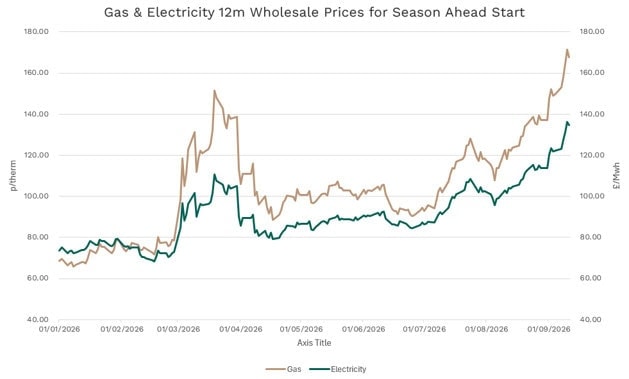
Energy markets saw strong volatility over the past six months as geopolitics took centre stage again, driving some contracts up to multi-year highs. While the US–Iran war, the closure of the Strait of Hormuz and the shutdown of Qatari LNG production were the main upside drivers, bullish fundamentals, such as extreme heatwaves and swings in renewable output, also provided significant support.
2026 started with optimism around strong global gas supply, however the declines were abruptly reversed on 28th February, following coordinated US and Israeli airstrikes on Iran, which triggered retaliatory missile attacks from Iran across the Middle East, including Qatar’s Ras Laffan LNG plant, leading to a full shutdown of the facility. What followed was several weeks of headline-driven volatility, with President Trump setting deadlines to reach a deal, threatening to “end a whole civilisation”, announcing a two-week ceasefire and eventually imposing a naval blockade on Iranian ports along the strait. Market sentiment softened in June after the US announced a 14-point Memorandum of Understanding (MoU), including plans to reopen the Strait of Hormuz, ease certain financial restrictions on Iran, and establish a framework for future discussions on Iran’s nuclear programme.
Markets then began rising sharply at the start of July, reacting to tightening supply fundamentals and heightened geopolitical uncertainty after the collapse of the MoU. This was followed by Iranian attacks on commercial vessels near Oman and a 13-day retaliatory bombing campaign by the US. Prices continued to surge through August and most of September as the strategic waterway remained closed and Yemeni Houthis took control of the Bab el Mandeb Strait, another important shipping bottleneck between Africa and the Middle East.
At the same time market fundamentals remained tight, driven by extremely warm weather, high cooling demand, and lower renewable generation. In France, heatwaves led to operational constraints at several nuclear facilities, as elevated river temperatures restricted reactor activity. Exceptionally low water levels on the Danube River forced the shutdown of nuclear units in Hungary and Romania, removing some non-thermal generation from the power mix and further tightening Europe’s supply.
The market eased slightly towards the end of September on hopes of renewed negotiations and the prospect of the Strait of Hormuz reopening, while temperatures remained above seasonal averages.
Gas Supply Outlook
Europe is once again entering the winter season with concerns about security of supply, driven by geopolitical tensions. When will the Strait of Hormuz reopen? Will it remain closed for the duration of winter? Even if it reopens, how quickly can Qatar resume operations and ramp up LNG exports, and how will this affect prices? These are some of the key questions traders are trying to answer ahead of the European heating season.
Qatar maintained some exports in Q3, but overall loadings dropped by around 90% compared with the start of the year. As a result, previous expectations of global LNG growth have been erased, despite higher output from other markets such as the US (Plaquemines, Corpus Christi, Golden Pass), Australia, Canada and Nigeria. According to LSEG (London Stock Exchange Group), aggregate Atlantic LNG supply grew by around 17 billion cubic metres this summer, but this is still insufficient to replace the lost Qatari and UAE volumes, which amount to approximately 30 bcm in total.
The tight supply situation increased competition between European and Asian buyers over the summer, and this is expected to continue over the next six months, as Europe needs to offer a price premium to attract vital LNG cargoes. Furthermore, the ban on Russian LNG imports from 1st January 2027 will increase Europe’s reliance on pipeline supply, storage and alternative sources of LNG.
As for pipeline gas flows, Norway remains a major supplier to Europe. Gassco completed most of its planned annual maintenance works in the North Sea at the end of September. The maintenance schedule is usually known in advance and priced in by the market; however, any unplanned outage could significantly impact prices, especially if it coincides with cold spells and peak demand periods. Norwegian production in Winter-26 is forecast to be 1 bcm higher year-on-year at 61 bcm, as the start-up of new gas fields offsets declines in maturing fields. On the other hand, both UKCS and Dutch production are expected to continue falling due to field maturation, making Europe even more reliant on imports.
Combined European gas storage currently stands at just over 72%, meaning that Europe is entering the winter season with a much smaller safety buffer than usual (below both the 90% November target and the lower 80% threshold). The shortfall might be partially offset by strong pipeline imports from Norway. This, coupled with expected demand reduction and potentially mild weather, at least in Q4, should help Europe balance the market; however, any unexpected outage or cold snap would provide additional support to prices. Furthermore, strong withdrawals and reduced LNG availability could leave Europe with very low inventories at the end of winter and support Summer-27 prices due to market tightness and higher storage injection demand in 2027.
Electricity Supply Outlook
Deployment of new renewable energy infrastructure across the UK and continental Europe has accelerated in recent years, reducing power supply risks. Increased penetration of renewables reduces gas-for-power demand and can pressure near-term electricity prices; however, it also creates additional price volatility in energy markets through the variability of intermittent generation. While reduced solar PV generation through the winter is predictable given the shorter days and lower solar irradiance, wind generation can be unpredictable and presents a greater challenge for grid operators in keeping the system balanced. As in recent years, so-called “Dunkelflaute” – periods with no renewable electricity generation due to low wind speeds and lack of sunlight – are an expected risk for the upcoming winter as well. So far, reports suggest mild and warm weather conditions in October, which could reduce heating demand, with windier conditions towards the end of the month. A Super El Niño is then expected to peak in December, bringing mild and windy conditions.
Precipitation is forecast to be strongest at the start of winter, especially in the Western Alps, which is much needed as the hydro balance is at its lowest in ten years due to the summer heatwaves. Hydro availability is also low in Norway, which could affect electricity flows to the UK.
An important factor for the UK power supply balance will be French nuclear availability, as France is a net exporter of electricity to the UK. French nuclear output is forecast to ramp up in October and remain close to Winter-25 levels, peaking at 55 GW in February. Given high gas prices, any unexpected outage or drop in nuclear output could support UK power markets. For example, the LSEG model suggests that a 10% drop in forecast output in October would result in a £2.6/MWh increase in the UK electricity price.
Despite falling output over the last ten years, the UK’s nuclear fleet continues to provide baseload supply to the grid, accounting for approximately 14% of the UK’s electricity generation mix. This is especially important when demand is high and renewable output is low due to weather conditions. EDF, which operates the UK’s nuclear fleet, has carried out extensive summer maintenance in preparation for the high-demand period ahead. As of now, three of the ten reactors remain on planned shutdown and are expected to gradually come back online by the end of November.
In its early view of Winter-26, the National Energy System Operator (NESO) outlined that operational margins – the surplus electricity beyond demand and reserve requirements – will be 5.5 GW, an 8.8% buffer over expected peak demand, meaning that the probability of supply shortages or blackouts is minimal. Nevertheless, NESO expects some tight days, most likely in January, when standard operational tools, such as notices to generators of the need for additional electricity supply, may be required.
Demand outlook
The recent surge in energy prices has pushed energy demand approximately 4–6% lower, which could, to a degree, help balance markets going into the winter season. Various forecasts suggest a potential reduction in both industrial and residential demand, although the extent of the former might exceed LDZ demand destruction. Production and operational changes due to high energy costs, as well as efficiency measures, will help reduce industrial demand, while household energy consumption might be affected by continuous electrification and a potentially mild winter.
Another important factor in reducing gas demand will be fuel switching in the power sector. Gas-for-power demand is expected to fall considerably due to higher generation costs compared with coal, coupled with increased renewable output. Overall, however, fuel-switching potential has fallen massively over the last ten years amid the coal phase-out in the European power generation mix, meaning that Europe now has less flexibility to switch off gas-fired CCGT plants when gas prices surge.
Generally, fuel switching can support demand for carbon allowances; however, this might be limited over the next few months as fuel-switching potential reaches its ceiling. The power sector is expected to continue supporting carbon prices due to high gas costs and geopolitical uncertainty, but any substantial increase in demand from utilities might be limited. Beyond the power sector, carbon markets are often driven by industrial demand, which has so far weighed on carbon prices because of geopolitical uncertainty, high gas prices, a gloomy economic outlook, and lower industrial output and power demand.
Surging gas prices pose a downside risk to the UK ETS as well; however, the UK carbon market has so far been resilient. The outlook for the UK ETS remains bullish due to the potential upcoming linkage of the EU and UK ETS schemes, but uncertainties remain amid ongoing delays, as the EU–UK summit has been postponed to November.
Weather-Related Risks
Weather is one of the major drivers of energy prices through its impact on demand. The increase in renewable capacity in the UK and across Europe, and the subsequent decrease in the share of fossil fuels in the electricity mix, mean that weather will continue to have a growing impact on price volatility.
Knowing what kind of winter lies ahead is key for the National Grid and for energy traders, as another “Beast from the East” could create new challenges to Europe’s supply demand outlook. Predicting the weather accurately beyond a 6–8-week timeline can be a highly speculative process given the enormity of interconnected global climate systems; nonetheless, there are several key indicators long range forecasters will look at to provide clues as to how seasonal patterns are likely to follow.
The best known is the North Atlantic Oscillation (NAO) index, which measures the difference in sea-level pressure between the Subtropical (Azores) High and the Subpolar Low and is considered a key driver of winter weather patterns in the Northern Hemisphere. A positive NAO is associated with more low-pressure systems and mild, wet winters in Europe, whereas a negative NAO indicates colder winters in Europe as a result of high-pressure systems.
If the upcoming winter turns out colder than normal, we might expect higher demand, price spikes, and heavier storage withdrawals. Given reduced LNG availability, this might result in depleted storages towards the end of March and even stronger gas injection demand throughout Summer-27. The latest forecasts suggest that mild and windy El Niño conditions will extend through Q4-26, but weather-related risks might increase in Q1-27, bringing colder temperatures to Europe and creating potential upside price risk in a tight global LNG market. Additionally, the US hurricane season, which normally lasts from June to the end of November, could put more Atlantic basin LNG supply at risk. So far this year, the Atlantic has reached the beginning of October without producing a single hurricane, which has not happened for over a hundred years; however, the season is not over yet and storms can still form over the next two months, which might affect US LNG production on the Gulf Coast and further tighten global LNG supply.
Key Takeaways
As a result of the US-Israeli war on Iran, escalating geopolitical tensions in the Middle East, the loss of Qatari LNG supply, and summer heatwaves, Europe is preparing to enter the winter season with limited gas stocks and high uncertainty. The market is expected to remain volatile amid lingering geopolitical threats. Europe can avoid supply shortages this winter and balance the market but there is greater upside risk than downside potential and cold snaps or unexpected outages could provide additional support to energy prices.
Below we have summarised some key takeaways and drivers on both the bullish and bearish side.
Bullish drivers:
- Geopolitics and headlines are expected to continue driving market volatility. Any escalation of the situation in the Middle East will most likely add a significant risk premium to already elevated markets.
- Disruption of LNG flows via the Strait of Hormuz, amounting to approximately 20% of global LNG, will increase competition between European and Asian buyers for LNG from alternative sources, such as the Atlantic basin. European buyers will therefore need to bid up to attract LNG vessels.
- One of the main concerns is low European gas stocks, currently standing below the five-year average and below EU targets. Strong withdrawals throughout Winter-26 would result in early depletion of storages and support both Winter-26 and Summer-27 prices.
- Although gas-for-power demand is forecast to be lower y-o-y, fuel-switching flexibility is limited; therefore, high gas prices will continue to support electricity costs.
Bearish drivers:
- Both industrial and residential demand are expected to decrease y-o-y, potentially weighing on prices;
- Strong Norwegian flows could partially offset low storage risks; however any unplanned outage will support both spot and longer-term prices;
- A Super El Niño is expected to bring mild and windy weather in Q4, which might pressure heating and gas-for-power demand, but there is a possibility of cold spells in Q1-27;
- Ample expected French nuclear output and strong flows to the UK could pressure spot prices and demand from CCGT gas-fired power plants.
Stay informed about your energy cost, compliance and procurement options:
Subscribe to Envantage’s Daily & Monthly Market Reports here.
Categories
Tags
Share this article
Explore our Procurement services:
Day One Fix contracts
Day One Fix contracts are designed to give businesses clarity and cost savings, without the complexity of managing market risks,
Discover moreFlexible Energy Baskets
Energy Baskets enable businesses to access the most competitive rates, by combining purchasing power. Envantage’s experts will help you to access the benefits of flexible purchasing, unlocking valuable savings for your business.
Discover moreFlexible Energy Purchasing
With the right flexible procurement strategy, it’s possible to align the control of your energy costs to your long-term business planning. Our expert consultants will help you to take advantage of the energy markets, bringing valuable insights on how they can work for your business.
Discover moreFixed Price Energy Contracts
A fixed approach can be a good choice to secure strong budgetary control if your energy consumption is predictable. With energy prices fluctuating from season to season, month to month and day to day, engaging with our experts early on maximises your chances of achieving the best fixed rate for your organisation.
Discover moreProcurement Strategy Review
Our expert consultants have the knowledge and experience to quickly and clearly identify an optimum approach to energy purchasing that fits with your appetite for risk and long-term goals.
Discover more


Abraham Moon
Envantage was recommended to Abraham Moon as a trusted energy and carbon consultancy partner. What began as support around Climate Change Agreements (CCA) and regulatory compliance quickly evolved into a joined-up programme covering carbon strategy, energy efficiency, procurement, and internal capability building.
Discover moreSubscribe to receive exclusive content and industry insights from our team of carbon and business energy experts, and our Daily & Monthly Market Updates.